Pipeline welding is not only about completing a joint. For contractors, utilities and infrastructure teams, the process also needs to be repeatable, verifiable and properly documented.
That becomes particularly important on projects involving PE and PP piping, where teams may be working across multiple locations and where welding records form part of quality-control and project documentation.
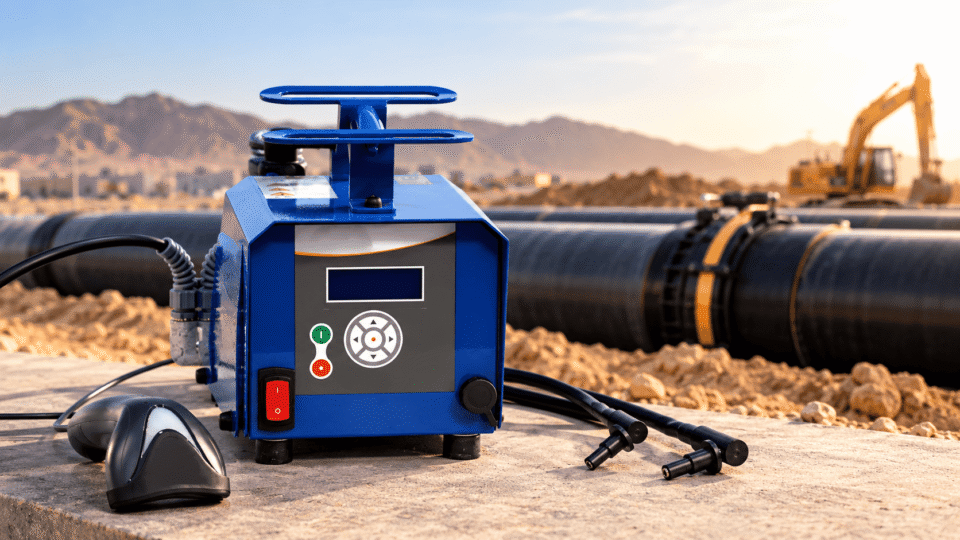
The PFS Tiny Data MF USB is an electrofusion control unit designed for welding thermoplastic pipes such as PE-HD, PE80, PE100 and PP with compatible electrofusion fittings. Depending on configuration, it combines barcode-based parameter input, SmartFuse functionality, welding-data recording, USB data transfer and Bluetooth connectivity in a compact field unit. PFS specifies the equipment for applications conforming to DVS 2208-1 and ISO 12176-2.
For contractors and technicians in Saudi Arabia, the significance is not simply that the machine performs electrofusion welding. It is the additional control and traceability that can be built around each weld.
What Is the Tiny Data MF USB?
The Tiny Data MF USB is part of the Tiny range of electrofusion control units manufactured by PF-Schweißtechnologie GmbH (PFS).
The unit is designed to supply the controlled electrical energy required by compatible electrofusion fittings. Depending on its configuration and the fitting being used, welding parameters can be entered through a barcode reader, SmartFuse, manual barcode entry, or manual entry of welding voltage and time.
PFS specifies an output-voltage range of 8–48 V AC for the current Tiny product family. The manufacturer’s current product information describes the Tiny range as suitable for municipal applications up to 400/630 mm depending on transformer type. Global Source lists the Tiny Data MF USB supplied in Saudi Arabia with a welding range of Ø20–630 mm.
This combination makes the unit relevant to applications ranging from smaller PE pipe connections to larger pipeline and infrastructure work, subject to the fitting, equipment configuration and applicable welding procedure.
Why Control and Traceability Matter in Electrofusion Welding
An electrofusion joint depends on more than simply connecting a fitting to a control unit.
Correct pipe preparation, suitable fittings, alignment, cleanliness, welding parameters and proper operating procedures all contribute to the integrity of the completed joint. The control unit therefore should not be treated as a substitute for correct electrofusion practice.
What equipment such as the Tiny Data MF USB can provide is greater control over parameter input and a digital record of the welding process.
That matters when a contractor needs to answer questions such as:
- Which fitting was welded?
- When was the weld performed?
- What welding parameters were applied?
- Who performed the work?
- Was an error recorded during the welding cycle?
- Which weld belongs to which project or job?
Instead of relying entirely on manually maintained site records, compatible data-recording variants can capture much of this information as part of the welding process itself.
1. Barcode Input Helps Reduce Manual Parameter Entry
Many electrofusion fittings carry a welding barcode containing the parameters required by the control unit.
According to PFS operating documentation, barcode information can include the fitting manufacturer, fitting type, diameter, fusion voltage, fusion time, resistance and resistance tolerance. Once the barcode is read using a compatible reading pen or scanner, the information is transferred to the control unit for processing.
This reduces the amount of welding information that an operator needs to enter manually.
For teams performing repeated electrofusion work, particularly across multiple fittings or project locations, barcode input can therefore help create a more consistent workflow.
The Tiny Data MF USB also permits manual entry of barcode digits where necessary, while PFS specifies manual welding-parameter input from 8–48 V and 0–9,999 seconds.
2. SmartFuse Can Automatically Determine Welding Parameters
SmartFuse is sometimes misunderstood as an electrical-overload protection feature. It serves a different purpose.
With a SmartFuse-compatible fitting, the control unit reads a reference resistor incorporated into one of the fitting’s connector pins. It can then automatically determine the appropriate welding parameters for that fitting.
For compatible systems, this provides another method of setting welding parameters without requiring the operator to enter them manually.
SmartFuse availability should always be confirmed for the specific control-unit configuration and fittings being used.
3. Welding Data Creates a Traceable Record
One of the more important differences between a basic electrofusion controller and a data-capable unit is what happens after the weld has been completed.
PFS documentation states that Tiny Data M(F) USB variants can record approximately 1,000 welding cycles. Recorded information can include:
General data
Time, date, report number, ambient temperature, welder name and job number.
Fusion data
Voltage, current, energy, nominal and actual welding time, welding mode, resistance and recorded error information.
Fitting data
Barcode information, fitting type, dimension and manufacturer.
Device data
Serial number, inventory number, service information, operating hours and system configuration.
Compatible systems also provide additional traceability functions for information such as worker identification, job numbers and pipe/fitting traceability barcodes.
For project teams, this means the electrofusion process can generate a usable digital record rather than leaving all documentation to be reconstructed afterwards.
4. USB Reporting Supports QA/QC Documentation
Recording welding information is useful only if that information can be retrieved.
PFS specifies USB output for Tiny Data MF USB variants, with welding reports available in PDF and CSV formats.
This can make the welding record easier to incorporate into project documentation and internal QA/QC processes.
For example, a contractor may need welding records for:
- Internal quality checks
- Project handover documentation
- Weld traceability
- Investigation of a recorded welding error
- Maintenance records
- Future reference
The exact documentation required will depend on the project, client specifications and applicable standards, but digital recording provides a stronger starting point than relying solely on handwritten records.
5. Bluetooth Can Extend the Digital Workflow
Bluetooth-equipped versions of the Tiny Data MF USB can communicate with PFS’s ElectroFusion Studio application.
PFS states that its Bluetooth LE functionality allows compatible electrofusion units to work with the app for controlling and recording the welding procedure. Use of this functionality requires a compatible Bluetooth-equipped unit and the appropriate PFS account/application setup.
This is particularly relevant as welding documentation increasingly becomes part of a broader digital project workflow.
However, buyers should confirm the exact configuration of the unit being supplied rather than assuming that every Tiny model contains the same connectivity and data functions.
Where Can the Tiny Data MF USB Be Used?
The unit is intended for electrofusion welding of compatible thermoplastic piping, including PE-HD, PE80, PE100 and PP, using electrofusion fittings with the appropriate input requirements.
In Saudi Arabia, that can make it relevant to several professional applications.
Water and Utility Pipelines
PE piping is widely used in infrastructure networks where controlled jointing and documented installation procedures can be important.
Gas Distribution and Pipeline Work
Projects requiring systematic electrofusion procedures can benefit from controlled parameter input and retrievable welding records.
Infrastructure Construction
Contractors working across multiple sections or project locations can use job and welding records to support project documentation.
Maintenance and Pipeline Repair
A compact electrofusion control unit can be useful for maintenance teams that need to move equipment between work locations.
Precast and Industrial Applications
Where compatible PE or PP piping components form part of a larger installation, electrofusion provides a controlled method for joining the appropriate components.
Key Tiny Data MF USB Specifications
Specifications can vary by model generation and configuration, so the precise unit being supplied should always be confirmed before purchase.
Global Source currently lists the following specifications for its Saudi Arabian Tiny Data MF USB offering:
| Specification | Global Source Listing |
|---|---|
| Welding range | Ø20–630 mm |
| Output voltage | 8–48 V AC |
| Input voltage | 230 V AC (190–300 V) |
| Input frequency | 50/60 Hz (40–70 Hz) |
| Display | 4 × 20 characters, backlit |
| Data recording | Yes |
| Barcode input | Reading pen |
| SmartFuse | Yes |
| Bluetooth | Yes |
| Interface | USB |
| Dimensions | 325 × 275 × 290 mm |
| Listed weight | 18.5 kg |
| Listed cord length | 4.5 m |
| Listed welding terminal | Universal 4.0 / 4.7 mm |
PFS documentation for different Tiny generations and configurations contains some specification differences. For example, an earlier PFS catalogue lists a 4 m welding cable, 4.0 mm terminal with alternative sizes available, and 21.3 kg transport weight for a specific Tiny configuration. Buyers should therefore use the specification of the exact unit being quoted, rather than combining specifications from different Tiny generations.
What Should You Consider When Choosing an Electrofusion Control Unit?
Diameter range is only one consideration.
Before selecting an electrofusion controller, contractors should also consider the fittings they regularly use, required welding-parameter input methods, project documentation requirements, traceability requirements and how the equipment will be used in the field.
For the Tiny Data MF USB, five questions are particularly useful:
1. What pipe and fitting sizes will you normally weld?
Confirm that the control unit and its duty cycle are appropriate for the intended fittings rather than relying only on the maximum stated diameter.
2. Do your projects require welding records?
If QA/QC documentation and traceability matter, a data-recording model offers capabilities that a basic controller does not.
3. Which parameter-input method do your fittings support?
Barcode, SmartFuse and manual parameter entry serve different workflows.
4. Do you need digital data transfer?
USB reporting—and Bluetooth on compatible variants—can simplify how welding information moves from the field into project records.
5. What local technical support is available?
Electrofusion equipment requires correct operation and periodic service. Access to training, maintenance and appropriate spare parts should therefore form part of the purchasing decision.
Local Support for PFS Electrofusion Equipment in Saudi Arabia
Equipment is only one part of a reliable welding operation.
Global Source supplies PFS plastic-welding equipment in Saudi Arabia and provides local technical support, maintenance services, original spare parts and operator training. The company’s PFS range includes electrofusion control units as well as associated pipe-preparation and welding tools.
For contractors operating in Riyadh, Jeddah, Dammam and projects elsewhere in the Kingdom, local access to product guidance and after-sales support can be an important consideration when selecting specialist welding equipment.
Frequently Asked Questions
What is the Tiny Data MF USB?
The Tiny Data MF USB is a PFS electrofusion control unit designed for welding compatible thermoplastic pipes and electrofusion fittings. Depending on configuration, it supports barcode input, SmartFuse, manual parameter entry, welding-data recording, USB output and Bluetooth functionality.
What pipes can the Tiny Data MF USB weld?
PFS specifies the Tiny Data M(F) USB family for electrofusion welding of thermoplastic pipes including PE-HD, PE80, PE100 and PP, when used with suitable electrofusion fittings within the equipment’s specified operating conditions.
What does SmartFuse do?
With compatible SmartFuse fittings, the control unit reads a reference resistor in the fitting connector and uses it to determine the welding parameters automatically.
Can the Tiny Data MF USB record welding data?
Yes. PFS documentation for Tiny Data M(F) USB data-recording variants specifies storage for approximately 1,000 welding-cycle reports, including welding, fitting, device and traceability information.
Can welding reports be exported?
Yes. PFS documentation specifies USB output and report formats including PDF and CSV for the relevant Tiny Data M(F) USB variants.
Does the Tiny Data MF USB support Bluetooth?
Bluetooth is available on compatible Tiny Data MF USB Bluetooth variants and works with PFS’s ElectroFusion Studio application. The exact configuration of the unit being purchased should be confirmed with the supplier.
Building Better Welding Records, Not Just Better Workflows
The value of a modern electrofusion control unit is not simply that it supplies power to a fitting.
For contractors managing increasingly documented infrastructure projects, the larger advantage is the ability to combine controlled parameter input, welding-process information and traceable records in one workflow.
The Tiny Data MF USB brings those capabilities together in a compact electrofusion platform designed for professional PE and PP pipe-welding applications.
For projects in Saudi Arabia, Global Source can provide information on the appropriate Tiny configuration, technical specifications, availability, operator training and support.
View the Tiny Data MF USB specifications or contact Global Source to discuss the requirements of your project.